
By Robin WenReviewed
Silicon Production: Purity Leaves the Solid
A carbon furnace stops at 98% because boron arrives with the quartz and survives the solid. Purity is reached by changing the molecule.
On this page
Silicon production is described as a purification chain, and the word hides a discontinuity. Metallurgical-grade silicon leaves an electric arc furnace at 98% to 99% pure, and polysilicon arrives at 99.9999% or better. Between those two figures the material stops being an element. It becomes trichlorosilane, a liquid that can be distilled, and only then is silicon deposited back into solid form.
That detour is the whole argument. Silicon can be made purer in a furnace, but not pure enough, because the two elements that matter most to a semiconductor — boron and phosphorus — survive every solid-state technique that works on metals.
Silicon production stops at 98% because the carbon brings boron in
The reduction is simple to write and awkward to run: silica plus carbon gives silicon plus carbon monoxide, in a submerged arc furnace with electrodes buried in the charge. The silicon leaves at 98% to 99.5%, and the metallic impurities in that figure — iron, calcium, aluminium, titanium — are the ones a later step can deal with.
Boron and phosphorus are different, and a 2018 USGS-funded study of the route states why in terms of where they come from: quartzite becomes the major source of boron and phosphorus
once cleaner carbon such as charcoal replaces coke, because the carbon source stops dominating the impurity budget. The quartz is a feed rather than a container, and its trace boron becomes the product’s trace boron at the same mass fraction it arrived with.
This is why ore selection is a production decision rather than a purchasing formality. The same study concludes that chemical characterization of quartz and quartzite sources places special emphasis on boron and phosphorus as compared to other impurities
. A deposit with the right silica content and the wrong boron level is not upgraded later; it is rejected before the furnace.
Neither leaching nor zone refining removes boron
The metallurgical toolkit offers several ways to lower impurity levels in a solid, and boron defeats most of them for one quantified reason. In the USGS-funded study of the route, the unfavorable segregation coefficient of boron (0.8) results in its ineffective removal during unidirectional solidification
.
Silicon production cannot escape this with heat alone: a segregation coefficient near one means the impurity does not prefer either phase. When the silicon freezes, boron stays distributed through the solid instead of concentrating in the liquid that is left behind, which is the mechanism zone refining depends on. Iron and aluminium, by contrast, have coefficients far below one, so they migrate and can be swept out. The same property is why silicon is used in aluminium alloys, where it is added for fluidity and where a wafer-grade purity would be wasted. A process built to reject metals cannot reject boron, and no number of passes changes that.
Acid leaching has the same shape of problem. It attacks impurities that sit at grain boundaries and in inclusions, and it works on the metals. Boron sits inside the silicon lattice, where a wash cannot reach it. The study’s own summary lists which fractions respond: leaching reduces elements with favorable segregation coefficients
, and boron is named separately as the case that does not.
The route leaves the solid phase, because a gas can be separated
What works is changing the molecule. Silicon is ground and reacted with hydrogen chloride to give trichlorosilane, a compound that boils at a low enough temperature to be distilled. Distillation sorts compounds by boiling point, and the boron and phosphorus chlorides have different boiling points from the silicon chloride — different enough to be separated in a column, which is a separation a solid cannot offer.
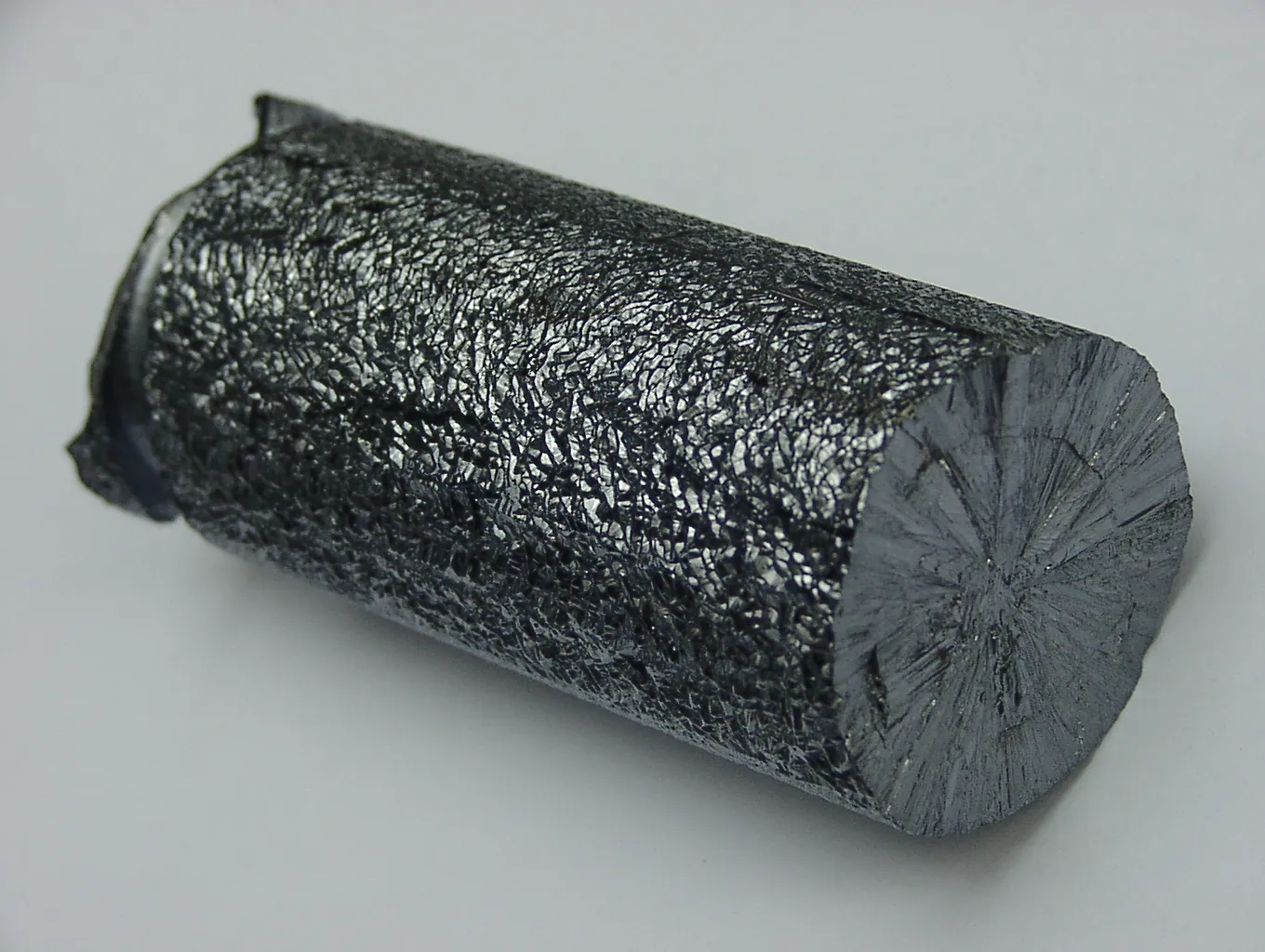
After distillation, silicon returns as a gas and is deposited onto heated filaments, which is what the Siemens process does and what the photograph at the top of this page shows: tapered rods whose shape is set by the filament they grew on. A fluidised bed does the same chemistry onto seed particles and withdraws granules continuously. The high-purity silicon page covers what those two reactor designs produce and what each grade is bought for; the point here is narrower. Both routes work because the purification happened while the silicon was not a solid.
The energy cost sits in that detour. Deposition runs near 1,000 °C and the chlorination and distillation steps consume chlorine and hydrogen that have to be recovered and recycled, which is why a polysilicon plant is a chemical works with a silicon output rather than a smelter with a purification step.
Can silicon reach solar grade without going through a chloride?
The obvious alternative is a silicon production route that purifies MG-Si to solar grade without going through a chloride at all, and the record on that is worth reading carefully because it is a record of attempts rather than of results. The same USGS-funded programme tested evaporation under reduced pressure and reported that limited experiments to date have not shown impurity reduction
, with work to continue under different conditions.
That sentence is not evidence that the metallurgical route is impossible. It is evidence that a specific attempt, at a specific scale, did not achieve what it was testing for. Two things follow. First, an upgraded metallurgical grade does exist commercially and is used in some solar cells, so the question is one of cost and achievable boron levels rather than of physics. Second, when a supplier claims a non-chloride route, the question to ask is the boron figure and the measurement method, because that is the number the chloride route exists to fix.
China holds four fifths of the silicon, and 2025 was a down year
USGS puts Chinese production of silicon materials at 4,000 thousand tonnes of silicon content in 2025, according to the 2026 Mineral Commodity Summaries, about 80% of estimated global output, against 3,100 thousand tonnes in 2021. The Mineral Commodity Summaries records the price consequence: the January–October 2025 average United States price for silicon metal was about 21% below the 2024 annual average, and Chinese silicon metal prices in April 2025 were the lowest since November 2016.
The reasons given are oversupply, weak demand from the aluminium and silicon industries, and the availability of polysilicon stocks. United States silicon metal imports in 2025 were estimated at about 50% more than 2024, with tariff uncertainty and concern about future export restrictions cited as possible contributors. For a buyer, 2025 was a year when the metal got cheaper while the policy around it got less predictable.
| Figure | Value | Basis |
|---|---|---|
| MG-Si purity from the arc furnace | 98–99.5% | Metallic impurities removed later; B and P are not |
| Boron segregation coefficient | 0.8 | Near one, so solidification does not reject it |
| China share of silicon materials | ~80% | 4,000 kt Si content, 2025 estimate |
| US silicon metal price, 2025 | about −21% | January–October average against 2024 |
Three numbers decide whether a route is worth quoting
The terminology is narrower than the process, and three quantities carry most of the risk:
- Boron and phosphorus in the quartz — set before the furnace and not repaired afterwards; reported per source, not per shipment.
- Segregation coefficient — the physical reason a given impurity does or does not move when silicon freezes; boron’s is 0.8.
- Chloride loop losses — chlorine and hydrogen recovered per tonne of polysilicon, which is where the chemical works spends its money.
What the process asks of a buyer
Three questions separate a workable specification from a wish:
- Which boron and phosphorus figures, and measured how. A grade sheet that gives total purity but not B and P is describing the part of the impurity budget that the process already handles.
- Which feedstock, and from where. Quartzite sets the boron, so a change of quartz source is a change of product even when the drawing does not move.
- Which deposition route. Siemens rods and fluidised-bed granules differ in form, in handling and in the contamination they pick up, and the grade names on a purchase order assume one of them.
High-purity quartz covers the feedstock side, where the boron question starts, and quartz production covers how that material is won and refined before it reaches a furnace.
Methodology
Purity figures, the boron segregation coefficient and the statements about quartzite are quoted from the USGS-funded study cited below, which reports work at pilot and developmental scale. The 80% Chinese share and the price movements are from the 2026 Mineral Commodity Summaries, whose table is in thousand tonnes of silicon content.
The claim that distillation separates boron and phosphorus from silicon is stated at the level the sources support: different boiling points, separable in a column. No specific boiling-point values are quoted here because they were not taken from a source in hand, and the argument does not depend on them.
Sources
- U.S. Bureau of Mines / USGS-funded study, “Solar Silicon via Improved and Expanded Metallurgical Silicon Technology,” OSTI 7235711 — quartzite as the major source of boron and phosphorus, the 0.8 segregation coefficient for boron, acid leaching and favourable coefficients, the reduced-pressure evaporation result. https://www.osti.gov/servlets/purl/7235711
- U.S. Geological Survey, Mineral Commodity Summaries 2026: Silicon, February 2026 — production by country in thousand tonnes of silicon content, the 80% share, the 2025 price movements, import volumes, tariff and export-restriction context. https://pubs.usgs.gov/periodicals/mcs2026/mcs2026-silicon.pdf
Related
- SpecificationHigh-Purity Silicon: Solar and Chips DifferHow high-purity silicon becomes solar cells and chips, why Chinese production clusters matter, and what purity figures leave out.
- UsesSilicon Uses: Four Destinations, One ElementCells, chips, aluminium alloys and silicones take silicon in four forms at four purities. Only one is bought by the kilogram.
- SuppliersSilicon Manufacturers: One Publishes a TonnageThe global polysilicon list is short, and only one company on it states an annual output. Below that line, every other name is a plant without a number.
- Photovoltaics · Critical MineralsGallium Uses: Two Compounds, Two IndustriesGallium arsenide turns current into light and back. Gallium nitride survives where silicon breaks down. The choice comes before any supplier call.