
By Robin WenReviewed
Quartz Production: Two Starting Points, One Crucible
Quartz glass is made either by melting purified sand or by burning a silicon gas. A crucible uses both, in two layers, in the same wall.
On this page
Quartz production starts from one of two materials, and the difference is not a grade within one process. Glass made by melting purified quartz sand is fused quartz. Glass made by burning a silicon-bearing gas is fused silica. They end up as the same substance — silicon dioxide, vitreous — reached from opposite directions, and the two words are used loosely enough in catalogues that a buyer holding a specification sheet often cannot tell which one produced it.
The distinction is drawn plainly by Heraeus Covantics: one route starts with high purity quartz, or other silicon dioxide containing minerals that are fused using various heat sources
, and the other starts with gaseous silicon containing chemicals (e.g. SiCl4) that are burned in the presence of oxygen to form silicon dioxide
.
| Fused quartz | Fused silica | |
|---|---|---|
| Feedstock | Purified natural quartz sand | A silicon-bearing gas such as SiCl₄ |
| How the glass forms | The sand is melted | The gas is burned in oxygen and the oxide deposits |
| Where purity is decided | Refinement of the sand, then the melting process | Refinement of the precursors, then the process |
| Shaped by | A die, a mould, or a vacuum chamber | Deposition and subsequent working |
The first half of quartz production: purified sand
The sand that feeds the first route is not beach sand, and the quantities involved are small: American ground high-purity quartz sold or used came to 100,000 tonnes in 2025 — an estimated figure, rounded by the Survey to the nearest 100,000 tonnes to avoid disclosing company data — at an estimated value between $500 and $12,000 a tonne, a spread the chapter attributes to the percentage of quartz, the type and level of impurities and the end use together (USGS, quartz). The USGS describes the American operation at Spruce Pine: the quartz comes out of pegmatite that were concurrently mined to produce feldspar and mica
, and The pegmatite was processed through a number of procedures that involved crushing, washing and scrubbing, and sorting
. Only then does the high-purity work begin, and the chapter separates it into three kinds: physical processing, chemical processing, and thermal processing
.
That ordering is the part worth carrying. Crushing and sorting are mineral processing: they separate quartz from feldspar and mica. Physical, chemical and thermal treatment are purification: they attack the impurities left inside the quartz grains themselves. A plant that does the first and not the second sells a concentrate, not a feedstock. Sibelco describes the district it works as mined for more than a century
, which dates the mining and not the purification step.
A customs schedule uses a much lower bar than the industry does, and the gap is worth knowing. The tariff line that covers high-purity sand, 2505.10.1000, is written for sand containing 95% or more silica and not more than 0.6% iron oxide, and it enters free; quartz and lascas under 2506.10.0050 are also free. Both rates are the normal-trade-relations column for 31 December 2025, and the same chapter records that high-purity quartz was affected by tariff negotiations during 2025 (USGS, quartz). The first line sets those two conditions and no impurity ceiling beyond them, and the second sets none at all, so on this page’s reading a customs entry does not distinguish 4N from 6N.
The grade ladder is defined at the end of that chain rather than at the start. Natural quartz with less than 100 ppm of total impurities is 99.99%, and ultra-high-purity products come in under 10 ppm, or 99.999%. High-purity quartz sets out what those numbers do and do not describe; what matters here is that they describe the output of the purification step, not the ore.
The second half of quartz production: three ways to melt it
Once the sand is good enough, the melting route is a second set of choices, and Heraeus separates three.
Continuous fusion pours sand into the top of a vertical melter built around a refractory metal crucible, holds the interior in a neutral or slightly reducing atmosphere so the silica does not react with that crucible, and draws the melt out of a shaped bottom orifice. Rods, tubes and plates come out of that orifice, which means the shape is set by the die rather than by later working.
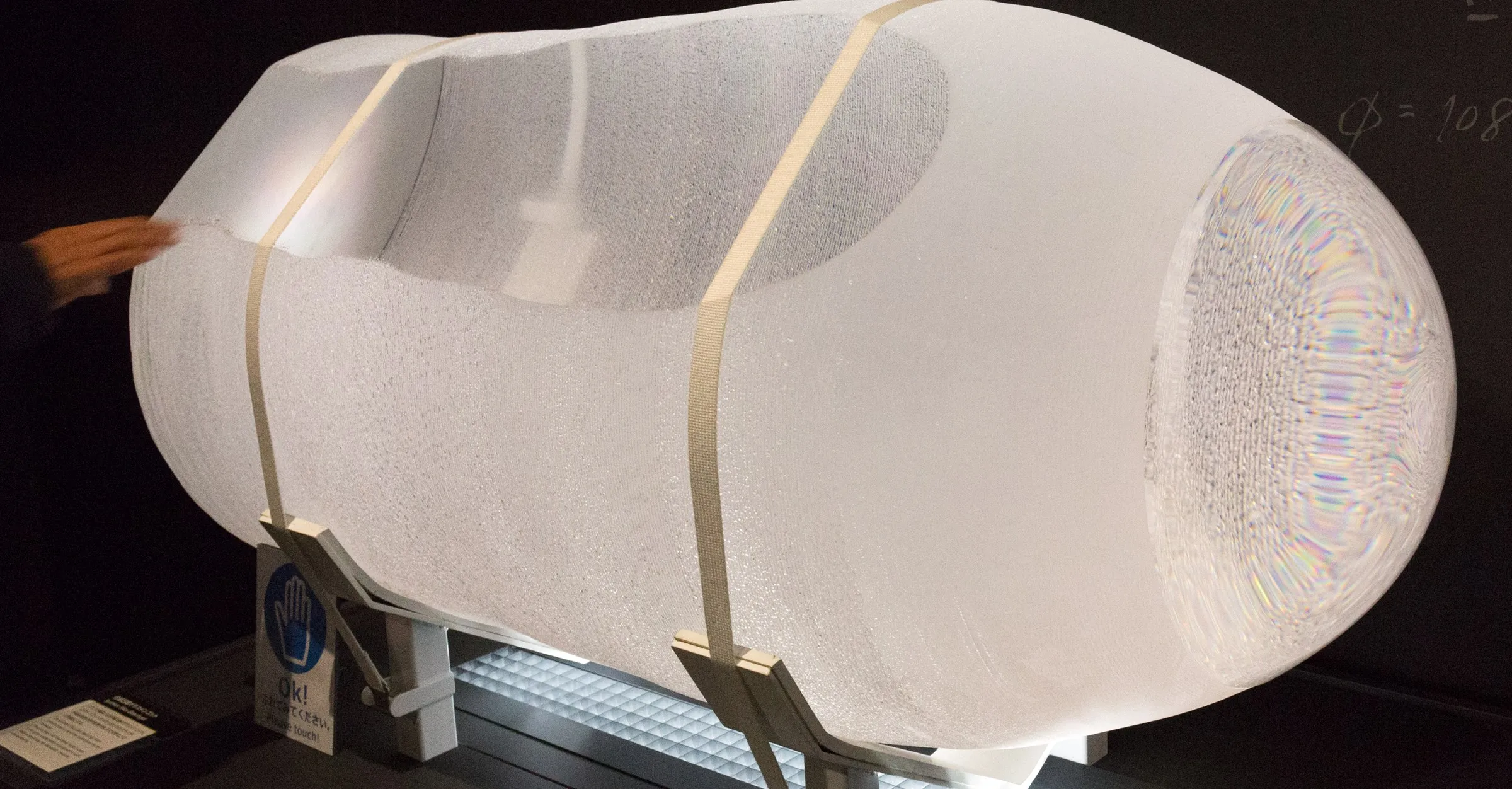
Batch or boule fusion puts a large quantity of raw material in a refractory-lined vacuum chamber and melts it in place, historically to make one large boule and now also to make smaller near-net shapes. The ingot in the photograph above is not one of these: it is synthetic, built up from a gas, and the fused-quartz boules of this method start from sand.
Flame fusion is the oldest. Heraeus’s own chemist Richard Küch began fusing rock crystal in a hydrogen-oxygen flame more than 100 years ago, and the industrial version feeds refined sand through a high-temperature flame onto the surface of a melt in a refractory-lined tank, which is then withdrawn slowly through a die
at the bottom.
| Method | Vessel | How the shape is set | What it suits |
|---|---|---|---|
| Continuous fusion | Vertical melter with a refractory metal crucible | A shaped bottom orifice | Rods, tubes, plates |
| Batch or boule fusion | Refractory-lined vacuum chamber | The chamber, then working | Large single boules, near-net shapes |
| Flame fusion | Refractory-lined tank under a flame | A die at the tank’s base | Continuous production, historically the first route |
The same page states, in its account of electric fusion and before the flame-fusion section: Purity is mostly determined by the extent of refinement of the raw material and the process used.
That is the whole argument against reading a purity percentage as a property of the ore.
The crucible puts both starting points in one wall
The most demanding form of this material is the crucible that holds molten silicon while a crystal is pulled in the Czochralski process, and it is where the two halves of quartz production meet. Sibelco sells the sand rather than the crucible, and names the crucible as its customer’s product: its IOTA sands are used to produce fused quartz
, and the first application it lists is the manufacture of fused quartz crucibles used in the Czochralski (CZ) process
. The JSQ division of SUMCO’s description of its own process is short enough to follow step by step:
- Filling. Quartz powder goes into a mould. In the synthetic version, the outside is filled with natural quartz powder and the inside with a higher-purity synthetic powder, which the company calls
a two-layer structure
. - Arc fusion. An arc discharge melts and vitrifies the powder at
over 2,000℃
, and the melting conditions are managed so that two layers form: a clear inner layer thatmostly does not have bubbles
and an outer bubble layer that raises heat retention. - Processing. The crucible comes out of the mould, is rinsed by high-pressure water to remove the quartz powder from its outer surface, and its rim is cut to a specified height.
- Inspection. Thickness, weight and outside diameter are measured, and every piece is visually inspected.
- Acid cleaning. Internal and external surfaces are cleaned with acid and rinsed.
| Step | What it is for | What it decides |
|---|---|---|
| Filling | Places two different powders where they are needed | Which grade ends up on the inside face |
| Arc fusion | Melts and vitrifies in one pass, forming the bubble layer | Where the clear layer and the bubble layer sit |
| Processing | Removes loose powder and sets the height | The finished dimensions |
| Inspection | Checks thickness, weight and outside diameter, piece by piece | Whether the piece ships |
| Acid cleaning | Removes surface contamination | The surface the customer receives |
Two things follow that a specification usually misses. The first is that the bubble layer is deliberate: it is there to hold heat, so a “bubble-free” requirement applied to the whole wall would be a requirement against the product rather than for it. The second is that the outer layer is natural quartz because it is more viscous at temperature and stiffens the crucible, which means the natural and synthetic routes are not alternatives here — they are different layers of one component.
The company also explains why the two starting points cannot simply be ranked. It states that synthetic silica glass has fewer impurities than natural silica glass, and gives the counterpart plainly: its viscosity is lower. That trade is the reason for the layering rather than a detail about it, because the outer natural layer is what supplies stiffness at temperature.
The service conditions make the point concrete, as that manufacturer describes them. A crucible holding the melt is exposed to 1,500 °C while the crystal is pulled, and the company groups deformation into two causes: the viscosity of the glass and the surface state of the crucible. Its measurement work adds one number that a specification can use, recording that deflection slows as the crystalline layer at the surface thickens, and that at 130 µm or more it falls to a rate where there are no substantial problems.
That is why this supplier measures viscosity rather than only quoting purity, and why a “fewer impurities” claim taken alone would be an argument for the inner layer only.
What the process decides that the certificate does not
Three consequences run through the whole chain.
The ore and the finished product can be in different countries. The USGS records that At least one of these companies sent their product overseas for further processing
, and it does not say which company or which direction. The Quartz Corp’s own history, which is a separate source, records quartz exploration at Drag in Norway from 1975 and high-purity quartz production there from 1996, plus a chlorination plant added at Drag in 2021 — so that company’s own history places processing in Norway as well as sites in the United States. Neither document states a flow between sites, and quartz suppliers sets out what each operator says about its own locations.
Purity is a property of a route, not of a deposit. Heraeus attributes it to refinement plus process. The USGS defines the grades as composition — less than 100 ppm of total impurities for 99.99%, under 10 ppm for 99.999% — and lists the purification steps separately, so the definition says what the material must be rather than where the number comes from. Neither source attributes it to the ground.
The form is set in different places. Continuous and flame fusion both shape the product at a die, arc fusion shapes it in a mould, and boule fusion makes a lump that has to be worked afterwards, or a near-net shape that needs less. A buyer specifying a shape is specifying part of the process, whether or not that is on the drawing. The end use decides how much of that detail matters: a wafer fab buying a crucible is buying viscosity and layer structure, while a lamp maker buying tubing is buying transmission.
What to ask before choosing a route
Five questions decide which of these processes a specification is actually asking for.
- Which starting point, natural or synthetic. The two are not interchangeable in a specification, and a sheet that says only “fused silica” may mean either substance.
- Where the purification happens, as distinct from the mining. Mineral separation and impurity removal are different operations and can be in different countries.
- Which of the three fusion methods. Continuous, batch and flame fusion give different shapes and different sizes, so the drawing has to match the melter.
- For a crucible, what each layer is for. Natural outside for stiffness, synthetic inside, bubbles outside for heat retention — a requirement that ignores the layering will contradict the product.
- Which measurement is the acceptance test. Viscosity and deformation matter for a crucible, dimensions matter for a tube, and a purity figure is not a substitute for any of them.
Quartz uses covers what the output is bought for. On the other side of the material, silicon production begins with quartz being reduced to metal, which is a different use of the same mineral.
Methodology
This page uses Heraeus Covantics’ account of fused quartz and fused silica manufacture for the two starting points, the three fusion methods, the atmosphere control and the statement on where purity comes from; the USGS Mineral Commodity Summaries 2026 chapter for quartz for the Spruce Pine processing description, the tonnage and price footnotes, the tariff lines, the 100 ppm and 10 ppm definitions and the note on overseas processing; The Quartz Corp’s published history for the Drag dates; on the JSQ division of SUMCO’s description of its crucible process for the filling, arc fusion, two-layer structure, processing, inspection and acid cleaning steps; and on Sibelco’s product page for the application it names, noting that Sibelco supplies the sand and not the crucible.
Two limits should be stated. The crucible process described here is one manufacturer’s published method, so it describes that company’s line rather than the industry’s only route. And the review this page would need for a comparison of the three fusion methods across suppliers does not exist in the sources read: the three are named and described, but not benchmarked against each other.
Sources
- Heraeus Covantics, “Making of fused quartz and fused silica” (two production routes, continuous and batch fusion, flame fusion, atmosphere control, refinement and purity). https://www.heraeus-covantics.com/knowlegde-base/making-of-fused-silica
- U.S. Geological Survey, Mineral Commodity Summaries 2026: Quartz (High-Purity and Industrial Cultured Crystal), February 2026 (Spruce Pine mining and processing sequence, purity definitions, overseas processing). https://pubs.usgs.gov/periodicals/mcs2026/mcs2026-quartz.pdf
- JSQ Division, SUMCO Corporation, “Quartz Crucible manufacturing method” (filling, arc fusion at over 2,000 °C, two-layer structure, processing, inspection, acid cleaning). https://www.jsq.co.jp/en/about/quartz/index.htm
- JSQ Division, SUMCO Corporation, “Our technology” (crucible deformation at 1,500 °C, viscosity measurement, the 130 µm crystalline layer). https://www.jsq.co.jp/en/about/technology/index.htm
- The Quartz Corp, company history (quartz exploration at Drag from 1975, production from 1996, chlorination plant 2021). https://www.thequartzcorp.com/articles/history
Related
- SpecificationHigh-Purity Quartz: What Crucibles DemandHow high-purity quartz becomes crucibles and quartzware, why natural and synthetic materials coexist, and what supply claims actually establish.
- UsesWhat Is Quartz Used For? Sand to WafersQuartz goes into glass, moulds, well completions, filters, silicon metal and oscillator circuits. The form decides which of those you can buy.
- SuppliersHigh-Purity Quartz Manufacturers: Two NamesTwo companies produce high-purity quartz in the United States, both around Spruce Pine. In 2026 one of them closed a plant there indefinitely.
- ManufacturingAluminum Uses: Two Properties, One MetalLightness and conductivity pull the same element apart. Structural uses alloy it freely; electrical uses cannot, and the trade costs about ten points.