
By Robin WenReviewed
Silicon Carbide Uses: Grit, Parts, Wafers
Abrasives, kiln furniture and power-device substrates buy the same compound. Three separate markets, three specs, and no route between them.
On this page
Silicon carbide uses fall into three groups: grit that removes material from other things, parts that survive heat and wear, and substrates that switch power. They share a formula and almost nothing else, and the practical question for a buyer is which of the three he is actually shopping for. Grit removes material from other things. Sintered parts survive heat and wear in places where metal would fail. Substrates switch power in electric vehicles. Each of the three buys the same compound, and none of them can use the other’s grade.
The prices make the separation obvious, and they are the quickest way to tell which silicon carbide use a quote belongs to. A tonne of abrasive-grade silicon carbide sold for roughly $829 on import in 2025. A 19-gram wafer of the same compound sold for about $235 in the same period. Both numbers are real, and neither market can serve the other.
The abrasive use: silicon carbide sold by the tonne
The abrasive use is the oldest silicon carbide use and the largest by mass, and it is the one a geological survey can count. USGS tracks silicon carbide inside its manufactured-abrasives chapter, where the 2026 abrasives summary records American production, an estimated value of about $25 million, and roughly 5% recycled content in 2025. The chapter also says what that grade is for: Bonded and coated abrasive products accounted for most abrasive uses of fused aluminum oxide and silicon carbide
.
What this market buys is a size distribution. A bonded wheel, a coated sheet and a loose blasting grain all specify mesh or FEPA size, and the buyer compares price per tonne at that size. The purchasers are foundries cleaning castings, stone shops cutting countertops and blasting operations preparing steel for coating.
What competes with it here is decided by cost per kilogram removed. Fused aluminium oxide is the main alternative in bonded wheels and coated sheets and is cheaper; garnet and steel shot take the blasting work. Silicon carbide holds its place where the workpiece is hard or where a sharper, faster-cutting grain pays for itself — carbide tooling, stone, and cast iron — and loses where the abrasive is consumed fast enough that price per tonne dominates.
The service conditions are forgiving by the standards of the other two uses. A grit particle cuts for seconds and is consumed; it does not have to hold strength at temperature or stay electrically stable for a decade. That is why the abrasive grade is the one sold on a commodity basis, and why the price is quoted per tonne rather than per part.
Sintered parts: sold by the piece, used where heat and wear meet
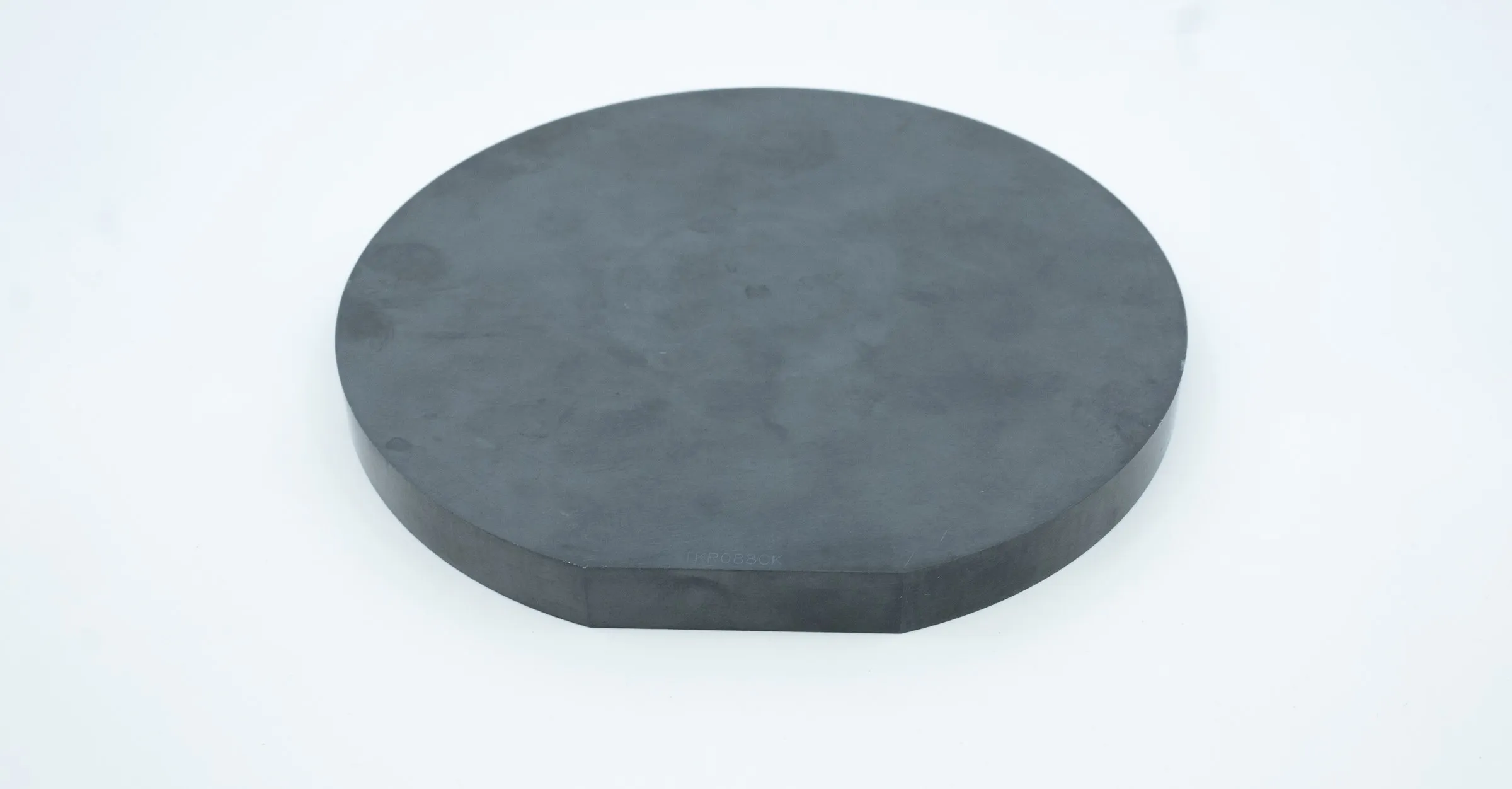
The second silicon carbide use behaves like a ceramic, and its specification is a set of numbers that have nothing to do with grit size. A sintered silicon carbide body is bought on density, mechanical strength and service temperature — 1,200 °C in air and 1,900 °C in an inert atmosphere for a typical grade, with 102.6 W/m·K thermal conductivity, a coefficient of thermal expansion of 4.02×10⁻⁶ K⁻¹ and a density of 3.1 g/cm³.
Those numbers explain where the parts go. Kiln furniture is the clearest case: a setter or a beam that carries ceramic ware through a firing cycle must not sag, must not react with the ware and must survive thermal cycling. Saint-Gobain’s kiln furniture literature makes the case for silicon carbide over alternatives on exactly those grounds.
Heating elements are the other piece-sold use, and they are the same logic applied to a different failure mode. Kanthal’s Globar range covers elements operating to 1,625 °C in diameters from 10 to 55 mm and lengths up to 6 m. An element is bought on geometry and on the temperature it will hold, not on its particle size.
The buyers here are kiln builders, heat-treatment shops and process engineers specifying a furnace. They buy tens or hundreds of pieces, not tonnes and not wafers.
The competition is other refractories, and the choice is usually a thermal one. Cordierite and mullite cost less and are adequate at lower temperatures; alumina holds up where chemical attack matters more than thermal shock. Silicon carbide wins where a load has to be carried through a fast cycle without sagging, and loses where the furnace runs cool enough that a cheaper refractory survives.
Substrates: sold by the wafer, used to switch power
The third silicon carbide use inverts everything about the first two. A substrate is a single crystal, bought in pieces a few hundred millimetres across, and its specification is written in diameter, thickness, resistivity and defect density. Nothing in the abrasive or the ceramic specification applies.
Where it is used is narrower than the other two: power conversion, at voltages and switching frequencies where silicon runs out of room. Traction inverters in electric vehicles take the largest share, followed by photovoltaic string inverters, fast chargers and power supplies in data centres. In each case the reason is the same pair of limits — silicon’s bandgap caps the temperature a device can run at, and its breakdown field sets how thick a drift layer must be, which sets the on-state loss.
What competes with it is silicon itself, at the low end. A silicon IGBT still wins on cost in most consumer and industrial drives, and the substrate price is why: a finished wafer costs far more per square centimetre than a silicon wafer, and that premium has to be repaid in efficiency and in heatsink size. Gallium nitride is the other challenger, strongest in the lower-voltage, higher-frequency corner.
The three do not trade with each other, which is the one thing worth remembering before reading any silicon carbide figure. A specification that reads as a quality ladder is really three separate products, and the table below is the shortest version of that.
| Use | What is specified | What nobody asks |
|---|---|---|
| Grit | Mesh or FEPA size, price per tonne | Service temperature, defect density |
| Sintered part | Density, strength, service temperature, conductivity | Mesh size |
| Substrate | Diameter, thickness, resistivity, defect density | Weight, price per tonne |
Three words a silicon carbide quote uses
- Grit size — mesh or FEPA, the only specification the abrasive customer reads.
- Sintered density — grams per cubic centimetre after firing, the number the ceramic customer reads.
- Polytype — the crystal stacking sequence, 4H or 6H, the number the substrate customer reads.
What the three silicon carbide uses ask of a buyer
- Which of the silicon carbide uses the quote belongs to. Per tonne, per piece or per wafer. A number without a unit in this material is not a price, and this is where most cross-market comparisons go wrong.
- Which specification that silicon carbide uses market will judge the part on. Abrasive size, sintered density, or crystal diameter and defect density. The other two specs are noise for this purchase.
- Whether the supplier actually makes that product. Crude silicon carbide and a substrate boule come from different plants with different equipment, even when the same company name is on both. The silicon carbide grade page covers how the families are designated and what the tariff split does to a loose grit versus a finished part.
Silicon carbide production covers how the furnace makes the crude material all three uses start from, and why the yield is 15 to 19%.
Methodology
Production volume, value, import unit value, the recycled share and the end-use statement come from the USGS Mineral Commodity Summaries 2026 chapter on manufactured abrasives, which reports the abrasive use and not the ceramic or substrate ones.
The ceramic property figures are from a supplier’s published data for a sintered grade; the heating-element range is from Kanthal’s Globar literature. The wafer thickness, kerf and lapping figures and the price series come from industry analyses cited on this page, not from an audited filing.
The 1.6-cent and 15,000-fold calculations are ours: 6.2 cm³ at 3.1 g/cm³ gives about 19 grams, and 19 grams at $829 per tonne gives about 1.6 cents. Using the ceramic density for a single crystal understates the crystal’s mass slightly, which makes the multiple a conservative estimate.
Sources
- U.S. Geological Survey, Mineral Commodity Summaries 2026: Abrasives (2026) — crude silicon carbide production, value, import unit value, recycling share and end-use statement. https://pubs.usgs.gov/periodicals/mcs2026/mcs2026-abrasives.pdf
- Saint-Gobain Ceramics & Refractories, “Why choose silicon carbide kiln furniture” — the kiln-furniture case for silicon carbide. https://www.ceramicsrefractories.saint-gobain.com/news-articles/why-choose-silicon-carbide-kiln-furniture
- Kanthal, “Silicon carbide heating elements” (Globar range) — service temperature, element diameters and lengths. https://www.kanthal.com/en/products/furnace-products/electric-heating-elements/silicon-carbide-heating-elements/
Related
- SpecificationSilicon Carbide: One Formula, Four GradesSilicon carbide is sold as grit, as a sintered ceramic and as a wafer. The numbers that identify each are not the same numbers.
- ProductionSilicon Carbide Production: Zone by ZoneOne Acheson run yields 15 to 19% saleable carbide. The core and the edge are different materials, because each impurity migrates its own way.
- SuppliersSilicon Carbide Manufacturers: Two FormsSilicon carbide manufacturers and suppliers split into two chains: abrasive grit sold by the tonne, and substrates sold by the wafer.
- SemiconductorsGallium Uses: Two Compounds, Two IndustriesGallium arsenide turns current into light and back. Gallium nitride survives where silicon breaks down. The choice comes before any supplier call.