· Robin Wen · Technology · 13 min read
The MATCH Act Draws Its Line at Today
The MATCH Act would exempt allied-owned fabs already in China, but not ones built later. That is a stricter rule than Washington applies to itself.
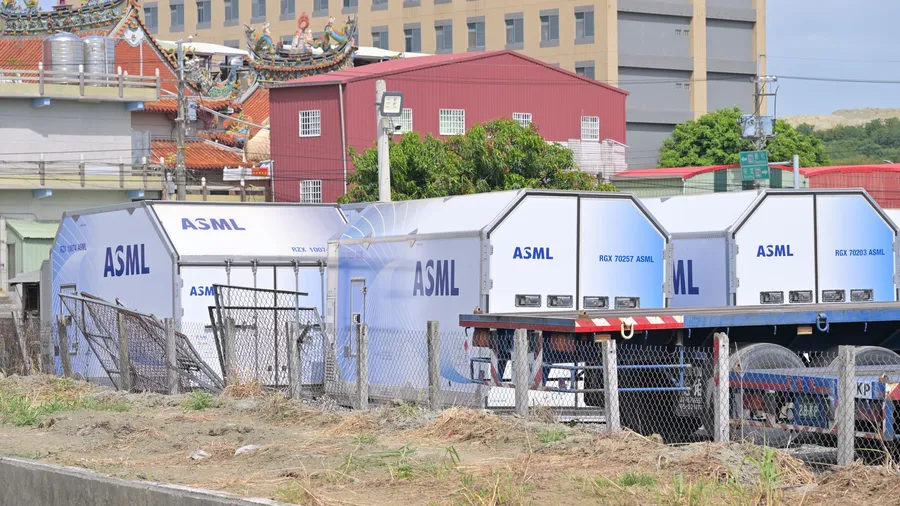
Photo: ASML air freight, Tainan, May 2025 · 4300streetcar · CC BY 4.0 · Wikimedia Commons
Two clauses, one difference
The MATCH Act, formally the Multilateral Alignment of Technology Controls on Hardware Act, would press America’s allies to adopt country-wide controls on advanced chipmaking equipment bound for any country of concern, and to require licences, refused by default, for servicing that equipment. It would not apply that rule to every fab. Plants that existed on the day the law passed, and that remain owned and operated by a company whose headquarters and ultimate parent are both outside the countries of concern, sit outside it.
Washington’s own rule does something similar and lands somewhere else. Under the current Export Administration Regulations, semiconductor manufacturing equipment bound for a fab in China that makes advanced-node chips carries a presumption of denial. End users headquartered in the United States, or in a country in Country Group A:5 or A:6, get the opposite outcome, so long as they are not majority-owned by an entity headquartered in Macau or in a destination listed in Country Group D:5, the arms-embargoed group that includes China, Russia, Iran and North Korea. For qualifying end users the review standard is a presumption of approval. The A:5 and A:6 groups include the Netherlands, Japan, South Korea, Taiwan and the United Kingdom.
Presumption of denial means an application is denied by default. Presumption of approval means it is granted by default. There is a third lane, case-by-case, for everything that falls between.
The countries of concern in the committee text are China, including Hong Kong and Macau, together with Iran, North Korea and Russia, and any further country on the arms-embargoed list as published on 1 January 2026 that the Secretary of State designates by published notice.
Both texts spare allied fabs. Only one of them asks when the fab was built.
Where the two rules part
The MATCH Act is not one bill but a family of them, and the version that matters for this comparison is the one the House Foreign Affairs Committee ordered reported on 22 April 2026. Its exemptions appear twice, in two separate definitions, using near-identical wording.
| Current US regulations | MATCH Act, committee text | |
|---|---|---|
| Where the carve-out sits | In the licensing policy | In the definitions of countrywide controls and of a key semiconductor manufacturing facility |
| What qualifies | End users headquartered in the US, A:5 or A:6, not majority-owned from Macau or Country Group D:5 | Fabs that existed at enactment and remain owned and operated by a firm whose headquarters and ultimate parent both sit outside the countries of concern |
| Asks when the fab was built? | No | Yes |
| Result for an allied fab already in China | Presumption of approval | No licence required at all, under this bill’s controls |
| Result for an allied fab built afterwards | Presumption of approval | Presumption of denial |
Read down the last two rows and the shape of the thing becomes clear. For the fabs that already exist, the MATCH Act is looser than current American policy. For the fabs that do not yet exist, it is stricter. The variable doing all the work is a date.
My reading is that this is not a loophole. It is a time gate, and what it protects is capital already committed rather than the allied firms that committed it. The two carve-outs also sit in different places. The American one is a licensing standard: an application is still assessed, and the applicant has to sit outside Chinese or D:5 ownership. The MATCH one is a definition. An excluded fab is not a key semiconductor manufacturing facility under it, so no licensing decision arises at all. The date test is not the only route into that definition: two further limbs reach facilities regardless of when they were built.
For a fab standing today, that is a better deal than Washington gives it. For a fab someone is deciding whether to build, it removes the option.
One qualification belongs with that table. It compares two licensing rules, not a fab’s whole regulatory situation, and a fab separately on the Entity List sits outside the comparison entirely. The American lane is also a category rather than a list: the regulation sets a standard, it does not name the facilities that meet it, and I did not check individual fabs against it.
How much the two lanes differ is easy to understate. A presumption of denial is not a licensing regime with a high bar. A CSIS study describes the United States policy on controlled chip sales to China as de jure a licence requirement and de facto a ban. The same logic runs through equipment. One lane is open with conditions attached. The other is closed with a formality.
The stakes are not evenly distributed either. Chipmaking equipment is the Netherlands’ largest export to China, Japan’s second and the United States’ third, in figures that Chris McGuire of the Council on Foreign Relations contributed to a House committee press release supporting the bill. That ranking is one reason this argument is being run through The Hague and Tokyo as much as through Washington.
What the Dutch are actually arguing about
The Hague is not asking Washington to abandon export controls on China. The Netherlands has tightened its own three times since 2023, and Dutch rules require export licences for ASML’s immersion DUV systems and, separately, for its EUV systems. The count of tightenings comes from the AI Policy Bulletin, an advocacy outlet that argues the Dutch controls should go further rather than less far; it puts the number of Chinese companies holding valid licences to import Dutch DUV machines at as many as 41 in April 2026.
Prime Minister Rob Jetten put the case in an interview with Bloomberg Television in New York on 24 September. He said protecting the domestic semiconductor industry matters, and that he was confident a workable agreement could be reached. That is a claim about who carries the cost, not about whether there should be a cost.
The Netherlands and China have been in a running dispute over Nexperia, the Dutch-headquartered, Chinese-owned chipmaker, since September 2025, when the Dutch government issued an order intervening in the company’s internal affairs and a Dutch court subsequently stripped its Chinese parent of control. China’s commerce ministry responded in November 2025 in unusually direct terms, and the two governments were still discussing a settlement in July 2026. The Netherlands and China are both parties to that dispute, and the account above rests on Chinese official outlets; I did not find Dutch or third-party reporting on the talks to set beside it. Whatever Beijing’s tolerance for Dutch equipment controls, it has already spent part of it on that fight.
The machinery, which is the part that bites
Scope is not where this bill has force. Timing is.
The committee text sets a sequence: within 90 days the relevant agencies must identify the choke-point equipment and the facilities that warrant control; within 120 days they must report on diplomatic progress; within 240 days they must either certify that allied supplier countries have adopted equivalent controls, or act.
Acting means the Commerce Department extends United States jurisdiction over allied-made equipment. The committee text lists several routes: controlling the equipment directly, restricting the end use of components already subject to American rules, removing existing licence exemptions, applying end-user or end-use controls to exports to any such facility, or clarifying how two specific provisions of the Export Administration Regulations apply, section 764.2 and General Prohibition 10. There is a one-time waiver of up to 60 days, available only with the agreement of four cabinet secretaries. If an allied country later materially weakens, suspends or revokes the controls that justified a termination, the United States must reimpose its own within 60 days.
That is not a one-time alignment. It is a standing obligation with a reversion clause.
The definition of servicing in the committee text is unusually wide. It covers installation, calibration, repair, overhauling, refurbishing, testing, diagnosis, software and firmware updates, training, field services, application support engineering, customisation, process adjustments, troubleshooting, technical assistance and the transfer of maintenance best practices. A machine that cannot be serviced is not the same asset as one that can. For fabs in China holding Dutch or Japanese tools, this clause is where the operating life of that equipment is decided.
The economic logic runs further. Capacity in advanced fabs is expensive, slow to build and slow to retire. A rule that reaches only new plants does not reduce the number of fabs in China this year or next. It changes the calculation for the plants that have not been committed yet, which is where the next increment of capacity would have come from. My reading is that this is a rule about the shape of the 2030 industrial map rather than about the current one.
Whether any of it happens
MATCH is not law. It passed the House Foreign Affairs Committee in April and has not moved since. The House passed its own defence authorisation bill on 22 July without any export control measures in it. The provision now sits among the amendments proposed to the Senate’s version of that bill, where the Senate has not yet voted on its own text.
The politics are contested in a way that cuts against the bill’s sponsors. Reporting on the legislation, including a monthly review by the Japanese trade promotion agency JETRO, has described these measures as a package that would challenge the administration’s softening stance on China, and the constraint is visible elsewhere: an amendment offered to the House defence bill in June would have attached this language to the annual must-pass vehicle, and the House did not adopt it.
My reading is that the binding constraint on MATCH is not congressional support. It has that, from both parties. The constraint is whether the White House wants to spend a trade truce on semiconductor tooling at a moment when it is negotiating an extension of a minerals arrangement with Beijing. The threat of extraterritorial control has been available for years. The open question has been whether anyone would use it.
Beijing’s own response carries a date that is easy to get backwards. China’s commerce ministry has said the bill, if enacted, would seriously disrupt the global semiconductor supply chain. That statement was released on 25 April 2026, in response to the committee vote, not to the Dutch prime minister’s comments five months later. I found no Chinese government response to the September event, and absence of evidence here is not evidence of absence.
What to watch, and what would settle it:
- Whether the Senate adopts the manager’s package holding this provision, and when
- Which deadline survives: the 240 days in the House committee text or the 150 in the Senate companion
- Whether Dutch control policy changes inside the window, and in which direction
- Whether the same mechanism is applied to the next allied supplier. The covered equipment classes are narrow, and the suppliers within them are few; a template that works on one country is available for the next
- Whether the Bureau of Industry and Security issues regulations extending American jurisdiction over allied-made equipment
Methodology
This piece compares two primary documents: the MATCH Act as ordered reported by the House Foreign Affairs Committee on 22 April 2026, and the current United States export control regulations as published in the Electronic Code of Federal Regulations. The comparison table is built from those two texts and from the country-group definitions they rely on, and from nothing else.
Two limits on that. The two chambers have written different bills. The House committee text sets deadlines of 90, 120 and 240 days; the Senate companion, S.4281, sets 60, 90 and 150, and a longer waiver. The comparison here is drawn from the House text, and where the two differ I have said so rather than reconcile them. And no one quoted in this piece spoke to me: the Dutch position comes from the government’s written answers to parliament, reported by Reuters, and from the premier’s own words in a Bloomberg Television interview.
Every source in the list below was fetched directly. Where a judgement is mine rather than a source’s, I have said so where it carries the argument.
Sources
- MATCH Act, amendment in the nature of a substitute, House Foreign Affairs Committee, 20 April 2026 — primary text; the two exemptions, the 90/120/240-day sequence, the servicing definition — docs.house.gov
- H.R.8170, all actions and text versions — legislative record; the 22 April 2026 order to report, and the bill’s movement since — congress.gov
- Implementation of Additional Export Controls, 87 FR 62186, 13 October 2022 — primary text; the rule that produced the allied-owner carve-out — federalregister.gov
- 15 CFR 744.23, supercomputer and semiconductor end use controls — primary text; the current American rule, including the presumption of approval for qualifying end users — ecfr.gov
- Supplement No. 1 to Part 740, Country Groups — primary text; the A:5, A:6 and D:5 group definitions used in the comparison — ecfr.gov
- Dutch government objects to proposed US law restricting ASML’s China exports, Reuters, 14 May 2026 — press; the Dutch government’s written answers to parliament, dated 12 May — reuters.com
- Statement regarding Dutch government’s updated export license requirement, ASML, 6 September 2024 — company statement; the current scope of the Dutch licence requirement — asml.com
- Dutch Export Controls Don’t Go Far Enough on China, AI Policy Bulletin, 1 April 2026 — advocacy; the “as many as 41” licence-holder estimate; argues the Dutch controls should go further, not less far — aipolicybulletin.org
- Amendment to Rules Committee Print 119-33 offered by Mr Baumgartner, 29 June 2026 — primary text; a proposed narrower control test, offered and not adopted — amendments-rules.house.gov
- US Multilateral Trade and Policy Developments, JETRO, August 2026 — trade body report; a summary of the bills in the Senate’s manager’s package, the 150-day figure that matches the Senate companion, and the House NDAA’s silence on export controls — jetro.go.jp
- China’s commerce ministry on the Netherlands’ semiconductor measures, Xinhua, 14 November 2025 — state media; Beijing’s response to the Dutch measures, recapping the administrative order of 30 September — news.cn
- China’s commerce ministry on the Nexperia talks, carried by CCTV and sourced to Xinhua, 17 July 2026 — state media; the July 2026 talks — jingji.cctv.com
- Understanding U.S. Allies’ Current Legal Authority to Implement AI and Semiconductor Export Controls, CSIS — think-tank analysis; the “de jure a licence requirement and de facto a ban” reading — csis.org
- House Select Committee on the Chinese Communist Party, press release supporting the MATCH Act — official; the co-sponsorship record, and McGuire’s export-ranking figures — chinaselectcommittee.house.gov
- Dutch premier on ASML export curbs, Bloomberg Television interview, 24 September 2026 — press; the interview in which the Dutch position was stated in the premier’s own words — bloomberg.com
- China’s commerce ministry on the MATCH Act, released 25 April 2026 — official; Beijing’s dated response to the committee vote, which predates the September lobbying — english.mofcom.gov.cn
- S.4281, MATCH Act, introduced in the Senate 13 April 2026 — primary text; the Senate companion’s deadlines of 60, 90 and 150 days, and its 90-day waiver — congress.gov