· Robin Wen · Finance & Markets · 14 min read
China's Data Property Certificates Can Finally Travel
China's national data registry issued 56 certificates in September. Provincial pilots had already issued more than 40,000. The difference is recognition.

Photo: CNPC data centre, Changping, Beijing · Charlie fong · CC BY-SA 4.0 · Wikimedia Commons
A register is only worth what a counterparty will accept. That is the test China’s new data property system is about to sit.
What happened in September
On 11 September China’s National Data Administration said it had formally begun registering data property rights nationwide. Ten days later it reported the first 56 certificates, issued to a mix of state-owned enterprises, publicly funded institutions and private companies. That middle category is one an outside reader tends to skip past: in China it covers hospitals, universities and state research bodies, which is how medicine and health, transport, information technology and scientific research all end up in one list. More than 15 of the 56 relate to artificial intelligence use cases.
The administration’s own description of what it has built is short: registration “provides identity documentation for data”, and makes ordinary business activity easier.
What the certificate actually records
It does not record ownership. Article 3 of the Working Guidelines for Data Property Rights Registration, which the administration issued on 1 July 2026, defines three distinct rights over one dataset.
The holding right is the right to keep lawfully obtained data, or to have another party hold it. The usage right covers processing, aggregating and analysing data to improve operations or to produce derived data. The operating right is the right to supply data to others, whether by transfer, licence, capital contribution or a security interest.
The three are independent. Under Article 21, one party may register all three, two of them, or one. And the same right over the same data may be held by several parties at once, who do not exclude each other. On my reading, that clause is the one that separates this register from a land title office, and it follows from the nature of the asset: a dataset can be copied without being used up, so exclusivity is not what the law is trying to price.
The certificate also expires. Under Article 26, registration is complete when the record is stored in the national system, and validity runs generally no longer than five years from that moment. Renewal can be applied for between six months and one day before expiry; once a certificate lapses, it stops working.
A document that several parties can hold simultaneously, over the same data, for no more than five years, is a checkable claim rather than a deed.
The number that is not in the announcement
Fifty-six is the first batch of one register. It is not China’s first attempt at documenting data rights, and the gap between the two numbers is the substance of this story.
The patent and trademark office has been running a separate register since it named eight pilot localities in November 2022, and later expanded the programme to 17. Its annual work report, published on 7 January 2026, gave cumulative results: the pilot localities had issued more than 40,000 data intellectual property registration certificates, and the financing guarantees and licensing those certificates supported came to nearly 15bn yuan. By June 2025 the patent office counted 58,000 applications and almost 30,000 certificates issued, with companies making up over 90 per cent of registrants.
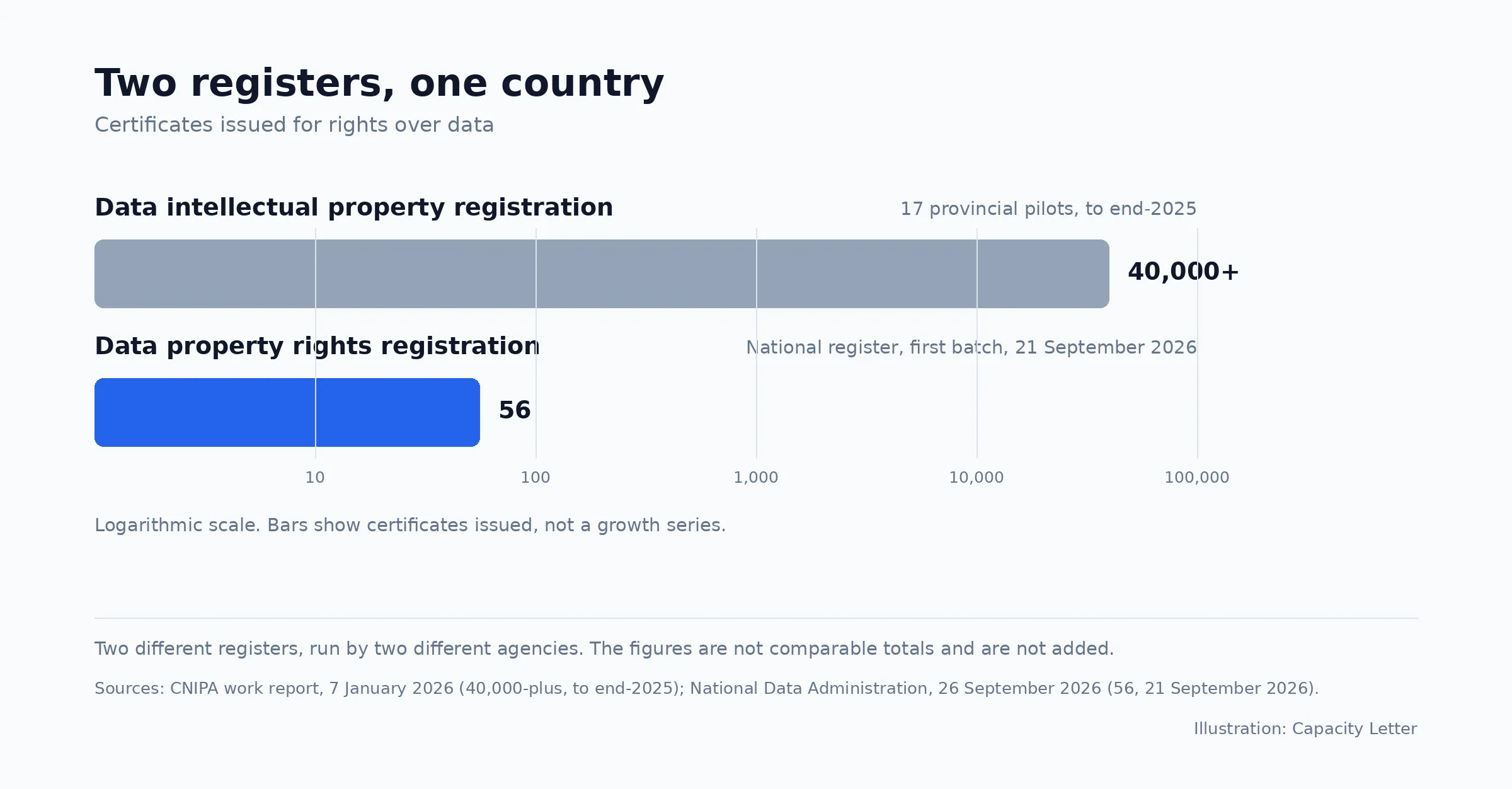
Illustration: Capacity Letter. Two registers run by two different agencies; the figures are not comparable totals and are not added. Logarithmic scale.
| Data property rights registration | Data intellectual property registration | |
|---|---|---|
| Run by | National Data Administration | China National Intellectual Property Administration |
| Began | national system in trial operation from September 2026 | provincial pilots from November 2022 |
| Reach | one national register | 17 provincial pilots |
| Certificates issued | 56 (first batch, 21 September 2026) | more than 40,000 (cumulative, as reported January 2026) |
| Financing and licensing supported | not yet reported | nearly 15bn yuan (cumulative, as reported January 2026) |
These are two different registers, two different agencies and two different legal hooks, and they should not be added together. What the comparison shows is demand. Tens of thousands of certificates were issued for rights in data long before there was a national system to register them in, and lenders and licensees were willing to act on the resulting paper.
What the paper could not do was travel. Luan Jie, director-general of the administration’s policy and planning department, described the problem on 11 September in terms that are hard to improve on: several types of data registration had been running in parallel, standards differed, and mutual recognition was lacking. The fix she announced is a single phrase, one registration valid nationwide.
What the merger changes in practice
The guidelines set the machinery. Registration runs through seven steps: application, acceptance, review, public notice, objection handling, evidence storage and issuance. A registrar must decide within three working days whether to accept an application, publish for five working days, and finish within ten working days. An extension of up to ten more working days is allowed where the sourcing is complex, the data is very large, or other such grounds apply; time spent on supplementary material, public notice and objections does not count. A refused application has five listed grounds, including unresolved ownership disputes and data obtained unlawfully.
Registrars are not shops. A corporate registrar needs paid-in capital of at least 100m yuan, at least two years of experience in data registration or a related data circulation service, a dedicated review team whose members have professional capability in data, law or a related field and at least three years’ experience, and a level-three security filing or above. It must keep records for at least twenty years, and it may practice anywhere in the country.
Article 31 then does the work that matters for cost. A certificate is admissible as proof of the rights and their content in four settings: data trading, balance-sheet recognition and financing, dispute resolution, and applications for data-enterprise support policies. The same article tells circulation service providers to accept a certificate issued under these guidelines, and, absent good reason, not to re-review the same data or charge a second fee for it. That sentence is aimed at the duplicate review that Luan Jie’s complaint implies: data examined once in one place had to be examined again somewhere else.
The downstream is already connected
Balance-sheet recognition is the channel that makes a certificate worth more than a filing receipt. Since 1 January 2024, under the finance ministry’s interim provisions of 2023, Chinese companies can recognise qualifying data resources as intangible assets or as inventory.
The volumes are early and concentrated. A tracking report from Shanghai Jiao Tong University’s advanced finance school counted 136 listed companies disclosing data resource recognition as of 30 April 2026, worth 3.79bn yuan, with 82 per cent of that booked as intangibles. The three state telecom operators alone account for 55 per cent of the listed total. The Shanghai Jiao Tong tracking report also counted 417 non-listed companies that had disclosed data resource recognition as of 31 March 2026, and 2.09bn yuan of financing raised by those non-listed companies, including bank credit and contributions in kind.
A separate tally by Securities Times, taken as of 7 May 2026, put the count at 134 companies and 3.86bn yuan, and named China Mobile at 1.11bn yuan, iFlytek at 315m yuan and China Unicom at 310m yuan. The two reports use different cut-off dates and slightly different scopes, and I cannot tell which is the better count. Either way the order of magnitude is the same: just over a hundred listed companies out of more than 5,000, and a total in the low billions. The channel is open, and not yet crowded.
What it does not do
Three limits belong with the claim.
Registration does not decide who owns the data, and it is not designed to. The 2022 opinion issued by the Communist Party and the State Council, which created this framework, named three rights: data resource holding, data processing and use, and data product operating. A commentary published by the data administration in March 2026, by Shen Weixing of Tsinghua Law School, records that the wording has since settled on holding, usage and operating rights, and that the three are meant to be combined flexibly, not held as a single bundle. The register records what a party has demonstrated, and disputes go to arbitration or the courts.
It does not settle a live fight. An unresolved ownership dispute is one of the five grounds for refusal, so contested data does not get a certificate at all.
And it does not decide anything across a border. Article 2 scopes the guidelines to registration activity carried out inside China. The rules governing whether a dataset may leave the country sit elsewhere, and are not examined here; the same question in the technology trade is what the MATCH Act piece is about.
That leaves three questions a reader outside China is likely to be asking. Can a foreign-owned company register data its Chinese operations hold? Is a certificate worth anything to a lender or a buyer abroad? Does any of this touch the export rules? The guidelines define an applicant as a natural person, a legal person or an unincorporated organisation, and on my reading of all 42 articles they impose no nationality test. That settles the first in principle. The second depends on the lender and the buyer, not on the text. The third sits outside this register.
What would change my mind
Three checks, all cheap.
The first is the register’s own arithmetic. Fifty-six certificates were published for public notice in September. If the same system is still reporting batches of this size in six months, then the binding constraint sits somewhere other than demand, and consolidation did not release it.
The second is whether the two registers converge. If the patent office’s data intellectual property register and the data administration’s property register end up recognising each other, or merging, then one registration really is becoming nationwide. If they keep growing side by side with separate paper, the country has added an eighteenth way to prove the same thing.
The third is the first named loan secured by one of these certificates. Financing against registered data already runs into the billions, but it was built on the pilot registers. A bank lending against a document issued under the July guidelines, with the amount and the borrower on the record, would settle the question of whether the certificate carries weight outside the system that issued it.
My reading is that September was a consolidation rather than a beginning, and that consolidation is the harder and more valuable of the two. Issuance turned out to be the easy half. Belief is the other half.
Methodology
Facts are drawn from the National Data Administration and its republication of state broadcaster reports; the full text of the Working Guidelines for Data Property Rights Registration (State Data Administration Composite Policy Document No. 35 of 2026), signed on 1 July 2026; the 15th Five-Year Plan outline, which calls for a unified national data property rights registration system; the patent office’s work report of 7 January 2026 and its republication of a Xinhua report of 17 September 2025; the finance ministry’s 2023 interim provisions; and two financial media tallies of balance-sheet recognition.
The two tallies of recognised data resources disagree on both the number of companies and the total, and I have shown both and picked neither. I could not obtain the original text of a claim that the city of Xiamen had issued 83 data property rights certificates by February 2026, and have left it out. The one interview name that appears in Chinese-language retellings of the September broadcast is spelled differently from the official transcript, so this piece gives the role and not the name. Figures for the two registries are taken from each agency’s own reporting and are described as such; they are not comparable totals and are not combined here.
Sources
National Data Administration, “我国发放首批数据产权登记凭证”, 26 September 2026, republishing a China Media Group report — first batch of 56, three rights, identity-document framing — nda.gov.cn
China Media Group, “数据也有’身份证’了 我国正式推行数据产权登记制度”, 11 September 2026, republished by the Fujian Development and Reform Commission — Luan Jie on parallel registers and mutual recognition; the two named registrar exchanges; the seven-step process; five-year validity; 56 certificates published for notice — fgw.fujian.gov.cn
China Media Group, “‘一次登记、全国通用’ 解码’数据产权身份证’”, 22 September 2026, republished by the Digital China Summit — three holder categories, more than ten sectors, more than 15 AI-related certificates, Shenzhen Airlines and JD.com statements, three-city filing — szzg.gov.cn
National Data Administration, “国家数据局综合司关于印发《数据产权登记工作指引(试行)》的通知”, State Data Administration Composite Policy Document No. 35 of 2026, signed 1 July 2026 — Articles 3, 7, 10, 21, 22, 24, 26, 28, 31, 32, 36: the three rights, registrar thresholds, non-exclusivity, refusal grounds, validity, deadlines and permitted uses — nda.gov.cn
National Development and Reform Commission, “中华人民共和国国民经济和社会发展第十五个五年规划纲要”, March 2026 — the sentence calling for a unified national data property rights registration system — ndrc.gov.cn
China National Intellectual Property Administration, “2026年全国知识产权局局长会议工作报告(摘编)”, 7 January 2026 — more than 40,000 data intellectual property registration certificates issued across the pilot localities, with nearly 15bn yuan in financing guarantees and licensing — cnipa.gov.cn
Xinhua, “近3万件数据知识产权助力数字经济发展”, 17 September 2025, republished by the patent office — 58,000 applications, almost 30,000 certificates and 90 per cent corporate registrants to June 2025; 17 pilot provinces in two waves — cnipa.gov.cn
China National Intellectual Property Administration, “数据知识产权试点地方增至17个”, 10 January 2024 — first eight pilots assessed and the programme expanded — cnipa.gov.cn
Ministry of Finance, “企业数据资源相关会计处理暂行规定”, Cai Kuai No. 11 of 2023, effective 1 January 2024 — data resources recognisable as intangibles or inventory — deloitte.com summary
Cailian Press, “136家上市公司披露数据资源入表事项”, 25 June 2026, reporting the Shanghai Advanced Institute of Finance tracking report — 136 companies, 3.79bn yuan, 2.09bn yuan of financing, sector and operator concentration — cls.cn
Securities Times, “A股数据资源入表成绩单出炉:134家企业入表38.6亿元”, 2026 — 134 companies, 3.86bn yuan, company-level detail — stcn.com
Yicai, “数据产权登记全国统一,影响哪些领域”, 7 July 2026 — the guidelines’ six chapters and 42 articles, the five refusal grounds and the three effects the administration expects — yicai.com
China National Intellectual Property Administration, “国家知识产权局办公室关于确定数据知识产权工作试点地方的通知”, 30 November 2022 — the eight pilot localities and the November 2022 start — cnipa.gov.cn
National Data Administration, “专家解读 | 如何理解数据产权’结构性分置’”, 14 March 2026, by Shen Weixing, Tsinghua University Law School — the 2022 opinion’s wording of the three rights, and the shift to holding, usage and operating rights — nda.gov.cn