· Robin Wen · Finance & Markets · 12 min read
Payment Terms Follow Scarcity, Not Rules
China's listed carmakers promised 60-day supplier payment in June 2025. On the fiscal-statement measure it is 187 days. Battery makers moved the other way.
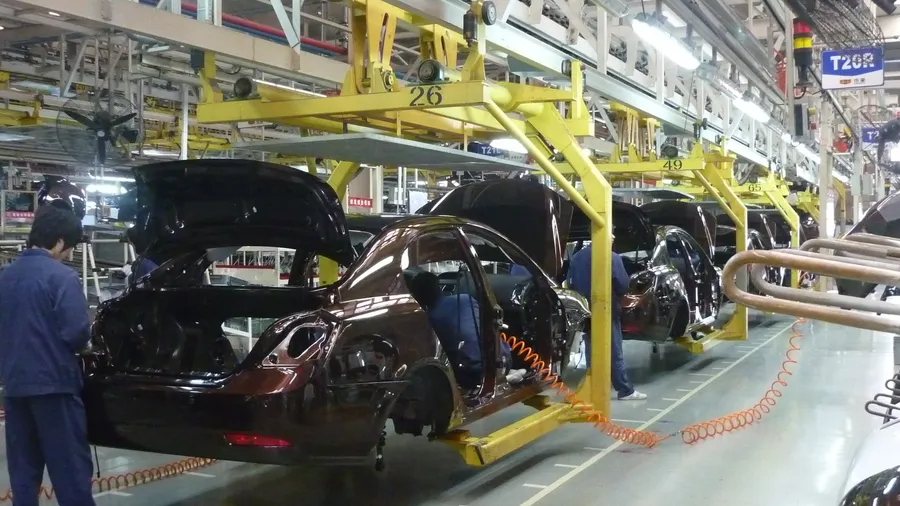
Photo: Geely assembly line, Beilun, Ningbo, 2011 · Siyuwj · CC BY-SA 3.0 · Wikimedia Commons · cropped to 1.91:1
In June 2025, seventeen Chinese carmakers publicly promised to pay their suppliers within 60 days. A year later, on the measure that can be computed from their own financial statements, the clock has got longer.
The interesting part is not that the promise failed. It is that the rule behind the promise already said exactly what the failure would look like, and that the one group in the same supply chain that did cut its payment terms did so for a reason that has nothing to do with compliance.
What the rule actually requires
China’s revised regulation on payments to small and medium-sized enterprises, State Council Order No. 802, took effect on 1 June 2025. Its mechanics are worth reading closely, because they are more specific than the pledge that followed them.
Article 9 sets the clock at delivery. A large enterprise buying from an SME must pay within 60 days of delivery, unless the contract says otherwise; and where the parties do agree a different period, it still has to be a reasonable one under the industry’s norms and practice. It also bans two specific devices: a contract cannot make payment conditional on the buyer receiving money from a third party, and it cannot scale payment to a third party’s progress.
Article 10 addresses the acceptance problem directly. A contract may make payment conditional on inspection or acceptance, and if it does, the clock runs from the date acceptance is passed. But the parties must set a defined, reasonable acceptance period and complete acceptance within it. And if the buyer drags, the clock starts at the expiry of the agreed period, not whenever acceptance finally happens.
Article 11 covers the instrument. Buyers may use commercial acceptance bills and receivables certificates if the contract says so clearly and reasonably. They may not force an SME to accept them, and they may not use them to extend payment terms by the back door.
Two further provisions matter later. Article 17 sets default interest on late payment at no less than the one-year loan prime rate, or, in the absence of any agreed rate, 0.05 per cent a day. Article 18 requires large enterprises to report the number and value of contracts with overdue SME payments in their annual report, published through the national credit information system.
That is the legal position: a defined start, a defined acceptance window, a ban on forced paper, interest, and a disclosure duty.
What the pledge produced
The pledges came nine days after the regulation took effect. On 10 and 11 June 2025, SAIC, FAW, Dongfeng, GAC, Geely, Changan, BYD, Seres, Chery, Great Wall, Nio, XPeng, Li Auto and others said they would unify supplier payment terms at 60 days or less. The China Association of Automobile Manufacturers had issued an industry initiative, and Article 6 of the regulation encourages large enterprises to make public commitments on payment terms. The pledge was a companion to the rule, not a substitute for it.
The measurement is where it gets awkward. Wind’s data, as reported by Cailian Press and Economic Observer, covers fourteen listed carmakers. Their average turnover days for accounts payable and notes payable ran at 170.0 days in the first half of 2025, fell to 164.4 days for the full year, then rose to 187.5 days in the first half of 2026, a deterioration of 23.1 days against the 2025 year-end figure. Thirteen of the fourteen got worse against the 2025 year-end. Only Li Auto improved.
| H1 2025 | FY 2025 | H1 2026 | |
|---|---|---|---|
| Average turnover days, 14 automakers | 170.0 | 164.4 | 187.5 |
| Payables and notes | RMB 782.5bn, up RMB 17.55bn on the 2025 year-end |
Payables and notes payable across the fourteen reached RMB 782.5 billion at the end of June 2026, up RMB 17.55 billion from the 2025 year-end. SAIC, BYD and Chery account for the largest balances, at RMB 187.1 billion, RMB 176.4 billion and RMB 145.7 billion respectively.
Two calibers, two numbers
The same fourteen carmakers produce two very different accounts of their own payment behaviour, and the gap is not small.
The association’s own survey, published in February 2026, found that most major carmakers had compressed payment terms within 60 days, with an average of about 54 days. Economic Observer puts the fiscal-statement figure at 187.5 days. The paper asked the association why, and got an answer worth quoting: the two are measuring different things.
The association’s number runs from the starting point of the clock, which may be acceptance or reconciliation, to the moment money actually leaves, by cash or by bank acceptance bill. The fiscal-statement number divides average payables by cost of sales and multiplies by 365.
The association’s own note on this says the calculated version can read higher than reality, because cost of sales excludes the cost of unsold product, and because payables in the balance sheet include acceptance bills. Economic Observer’s conclusion is narrower than that: the absolute level is not comparable across the two calibers, but the fiscal series’ own movement still tells you where those terms are going. On that measure the movement is worse.
The headline number is contested too. One account of this quarter’s results puts fourteen listed carmakers’ supplier payables above RMB 1.2 trillion. Wind’s figure for fourteen companies is RMB 782.5 billion. I could not obtain either company list, so I cannot say the larger number is wrong: it may cover a different set of companies or count a different item. What can be said is that the two totals most often quoted for fourteen listed carmakers in the same quarter differ by more than 50 per cent. Readers comparing accounts will meet both.
The counter-current in batteries
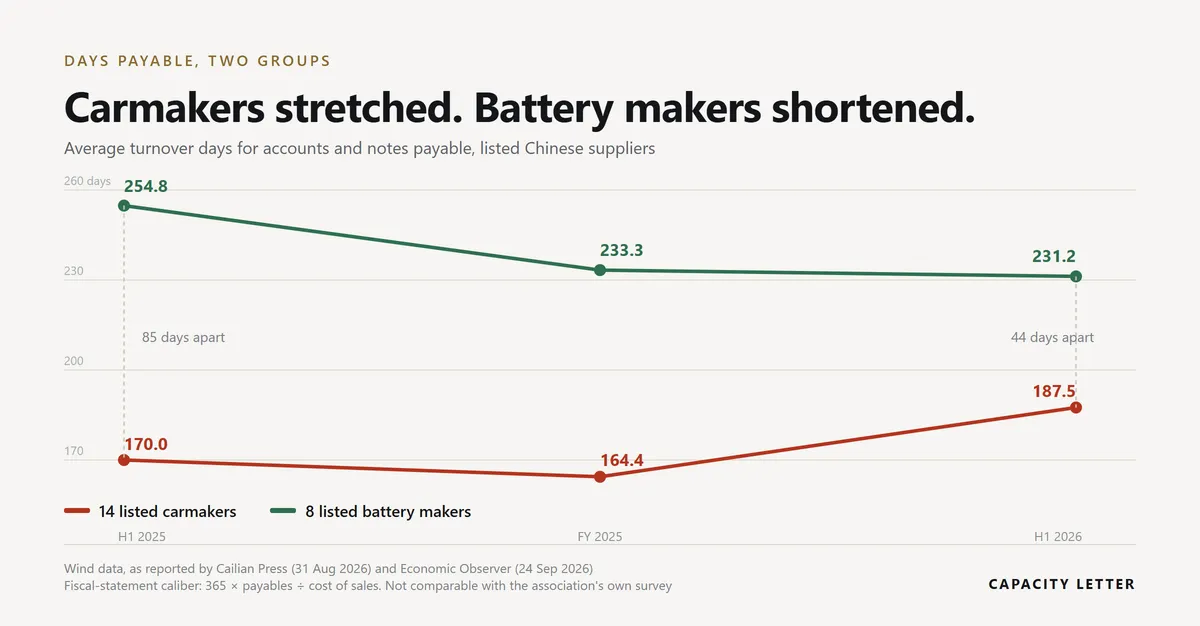
Illustration: Capacity Letter. Average turnover days for accounts and notes payable, Wind data as reported by Cailian Press (31 August 2026) and Economic Observer (24 September 2026). Fiscal-statement caliber, 365 times payables divided by cost of sales, which the China Association of Automobile Manufacturers says reads higher than its own survey measure; the two are not comparable in level.
Eight listed power-battery makers tell the opposite story. Their average turnover days fell from 254.8 in the first half of 2025 to 233.3 for the full year, then to 231.2 in the first half of 2026, a year-on-year improvement of 23.6 days. Seven of the eight improved.
The mechanism Economic Observer gives is not regulatory. It is scarce supply. Battery demand improved through 2025 and 2026, and the sector moved into profit: seven of the eight posted gains, most of them doubling or better. At the same time, upstream materials tightened. Prices for lithium carbonate and lithium hexafluorophosphate rose sharply over the year, and the materials end of the chain went from surplus to shortage. Economic Observer’s phrasing is direct: to lock in supply, battery makers had to pay fast and in cash.
The counter-example inside the counter-current is instructive. Farasis Energy cut its turnover days by 90.0 days to 178.4, the largest fall in the group. But its revenue fell and its loss widened, and its notes payable halved from RMB 3.71 billion to RMB 1.81 billion. Economic Observer reads the improvement as a contraction in bill credit and purchasing, not as an increase in willingness to pay.
In late June 2026 the battery industry associations and eleven battery makers signed a payment-terms initiative of their own, setting a 60-day maximum for SME suppliers, a seven-working-day acceptance standard for materials and components, and all-cash payment for SMEs. It had almost no effect on the first-half numbers, because it arrived at the end of the period, and because the improvement had already happened without it.
What the regulator knows
The ministry responsible has said plainly where the problem sits. Speaking in September 2026, an official of the Ministry of Industry and Information Technology noted that payment involves many steps, that subsidiaries and branches differ widely, and that the starting point is not standardised: acceptance on delivery, centralised reconciliation, receipt of invoice and fitting to the vehicle all serve as different standards, producing different actual terms.
That is the regulation’s central term of art, and the regulator has just said the market runs four versions of it. A survey of suppliers conducted by Beijing News in August 2025 found almost the same spread: a third said the clock started at acceptance, a third at invoice, and the rest split between order confirmation and arrival at the carmaker’s warehouse. Two thirds said acceptance bills had reduced but not disappeared.
Three instruments followed. In July 2025 the ministry opened a complaint window for the payment pledges, receiving four categories of problem, the second of which names unreasonable starting points and delayed acceptance certificates as disguised extensions. In September 2026 the ministry and the market regulator jointly issued the first national document aimed specifically at payment terms in the car industry, covering the start date, the acceptance period and the fitting-to-vehicle period, and prohibiting forced or disguised use of commercial acceptance bills. A week later the ministry said it would have a third party build a graded evaluation mechanism for the pledges, with joint interviews for companies that deliberately stretch terms or attract repeated complaints.
Note what moved. The original promise was about a number, 60 days. The instruments that followed are about a date.
What to watch
Article 18 gives the cleanest way to check any of this from outside. Large enterprises must put the number and value of contracts with overdue SME payments into their annual report, published through the national credit information system. If that is done, the 2026 annual reports will be the first dataset covering a full year under the new rules that anyone can audit line by line. If it is not done, the omission is itself a finding, and Article 34 gives the market regulator a basis to act on it.
My reading is that the 60-day figure was not the binding variable, and that the battery data shows why. Where supply is tight, cash arrives quickly, because the buyer needs the material more than it needs the float. Where supply is abundant, the clock stretches, because the buyer can take the float and lose nothing. A rule can define the starting point, ban the paper that smuggles the extension, and require the disclosure. It cannot make a supplier scarce.
What would change my mind: if the 2026 annual reports show the thirteen that worsened reversing, the policy will have worked, only slowly. If the battery improvement is traced to the June initiative rather than to material costs, then the scarcity explanation is too strong and terms are more responsive to rule-making than this data suggests.
Methodology
This piece is built from a Chinese-language lead and does not rest on it. Every load-bearing figure is attributed in the list below, and the source’s role is stated there.
Two things I did not establish. The first is the company list behind either of the two totals quoted for the fourteen carmakers, which is why I have reported both rather than picking one. The second is the annual-report disclosure under Article 18: I have not checked whether any of these companies complied for the 2025 reporting year.
Where a judgement is mine rather than a source’s, I have said so. That the two calibers agree on direction while disagreeing on level is Economic Observer’s conclusion, not my inference. That scarcity rather than compliance explains the battery improvement is Economic Observer’s reading of its own data, and I have adopted it as the most economical explanation of the numbers they give. That the fight has moved from a number to a date is my reading.
All operating figures attributed to individual carmakers about their own payment performance come from the companies themselves, relayed by the sources below, and are reported as company statements.
Sources
- State Council Order No. 802, Regulation on Ensuring Payments to Small and Medium-sized Enterprises, revised 18 October 2024, effective 1 June 2025 — primary legal text. Articles 6, 9, 10, 11, 17, 18, 24, 25, 26, 31 and 34 read in full — mee.gov.cn
- Economic Observer, “It grew another 23 days in the first half; why do some carmakers’ payment terms get longer the more they are governed”, 24 September 2026, by Zhou Ju — original reporting: the Wind-caliber series for fourteen carmakers, the association’s explanation of the two calibers, the battery series and its mechanism, the ministry’s September remarks, and the company-level rankings — huxiu.com
- Cailian Press, “Fourteen carmakers’ payables and notes exceed RMB 780 billion; average turnover days lengthen 23 days”, 31 August 2026, by Liu Yang — financial press, Wind data. The RMB 782.5 billion total, the 170/164/187 average series, and the SAIC, BYD and Chery balances — cls.cn
- Beijing News Shell Finance, “Survey report on the execution of the 60-day payment pledge: four problems needing improvement”, 29 August 2025 — original supplier survey: the distribution of starting points, the acceptance-bill findings, new-versus-old contract treatment, and the confidence question — bjnews.com.cn
- LatePost, “Fourteen listed carmakers’ supplier payables pass RMB 1.2 trillion”, 25 September 2026 — the lead, used as an entry point. Its RMB 1.2 trillion total is reported in the body as a conflicting account, not as established fact — latepost.com